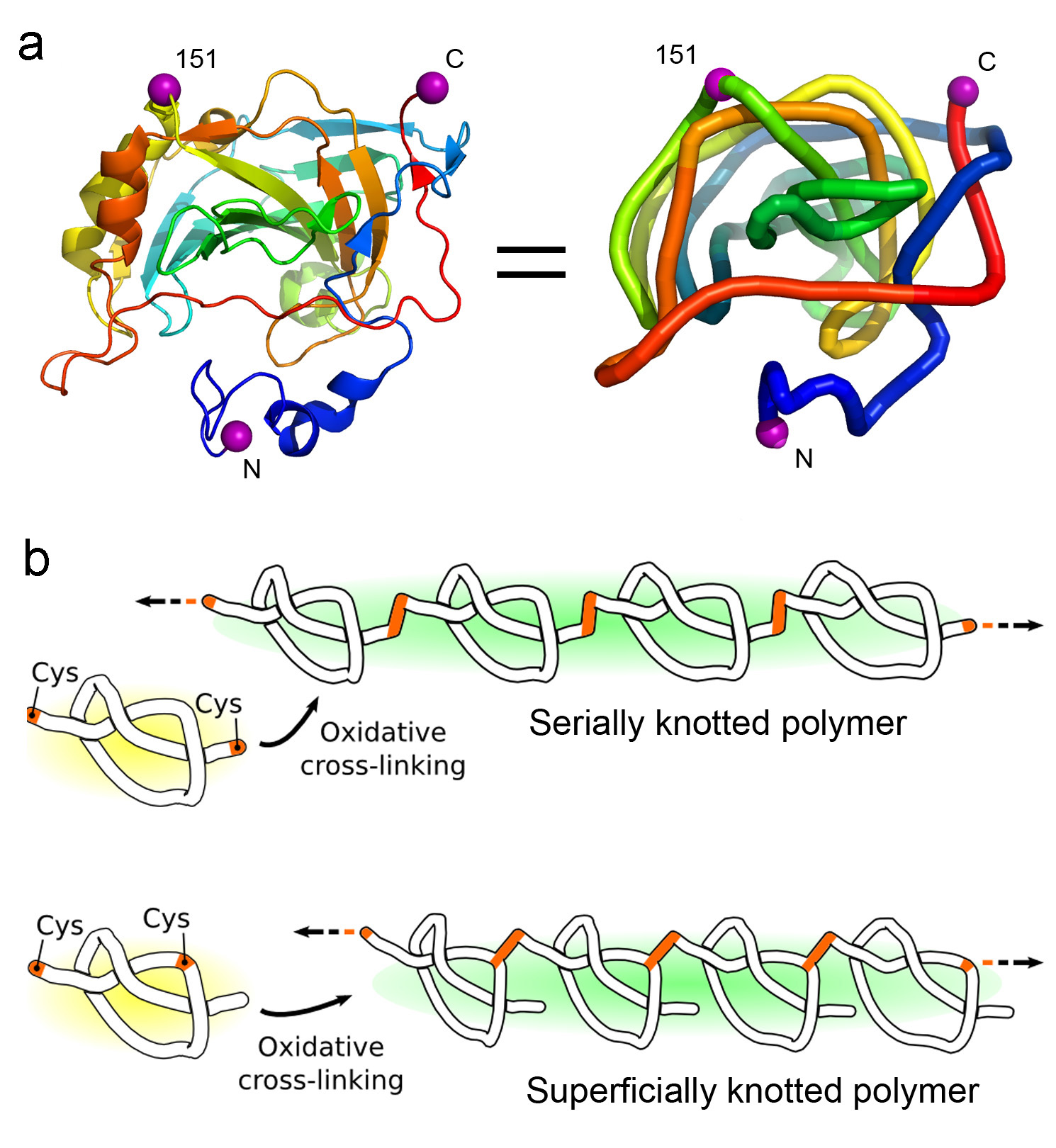
Although proteins often adopt rather complex folds, the fact of the matter is that the backbone of a protein molecule adopts a knotted configuration in only a very few proteins among the thousands of known protein folds. This is contrary to what would be expected if protein backbones followed essentially random paths in space; for spatial curves as long as medium-sized proteins, knots would be expected to dominate. The observation that native protein folds hardly sample the space of knotted conformations – a space that represents the majority of all possible conformations – has profound implications for protein folding in general, and for the Thermodynamic Hypothesis (first posed by Anfinsen) in particular.
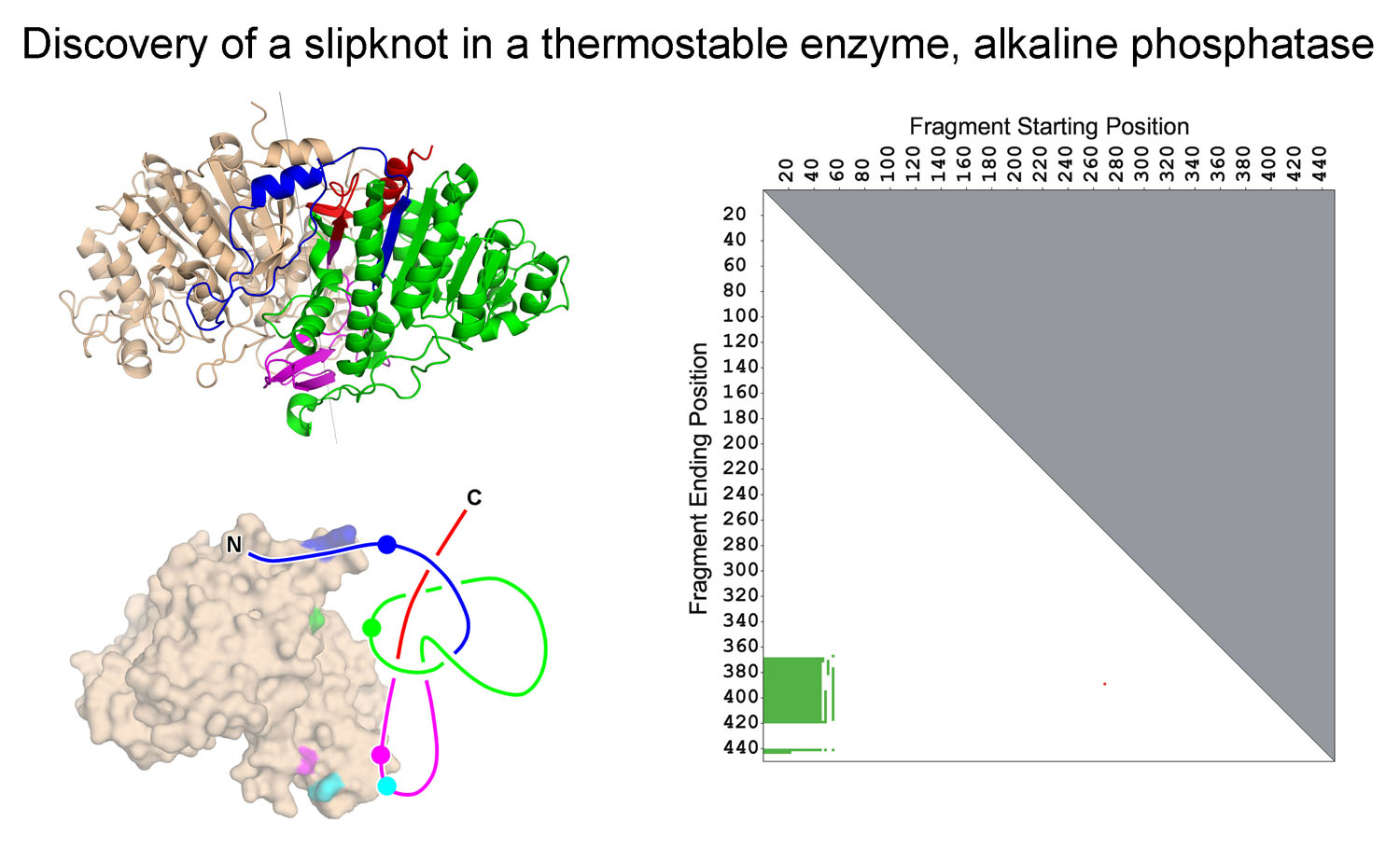
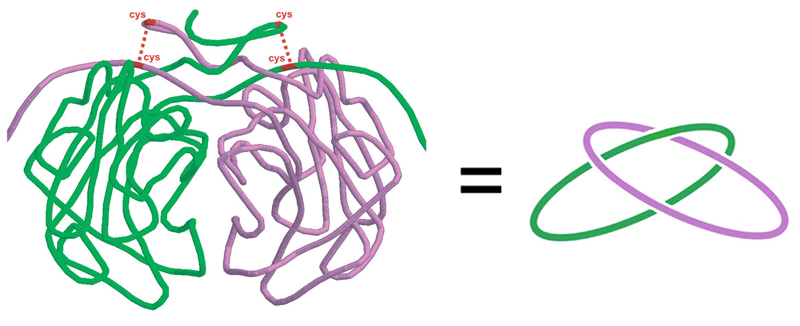
Despite their rarity, there are a few special cases where knotted proteins have been observed, and these provide special opportunities for studying protein folding and stability. The intuition that it might be kinetically difficult for a knotted protein chain to reach its native state can be considered in reverse, with the conclusion that knotting and other kinds of topological entaglements could kinetically stabilize the folded states of proteins containing these features. While looking for unusual topological features in protein stuctures, we (Neil King) discovered a novel slipknot feature in a well-known thermostable protein, alkaline phosphatase. Beyond the knotting of individual protein chains, a few rare cases are known in which protein chains from two different subunits form topologically interlinked chains. One of these was discovered in the lab by Danny Boutz in the citrate synthase dimer from P. aerophilum.
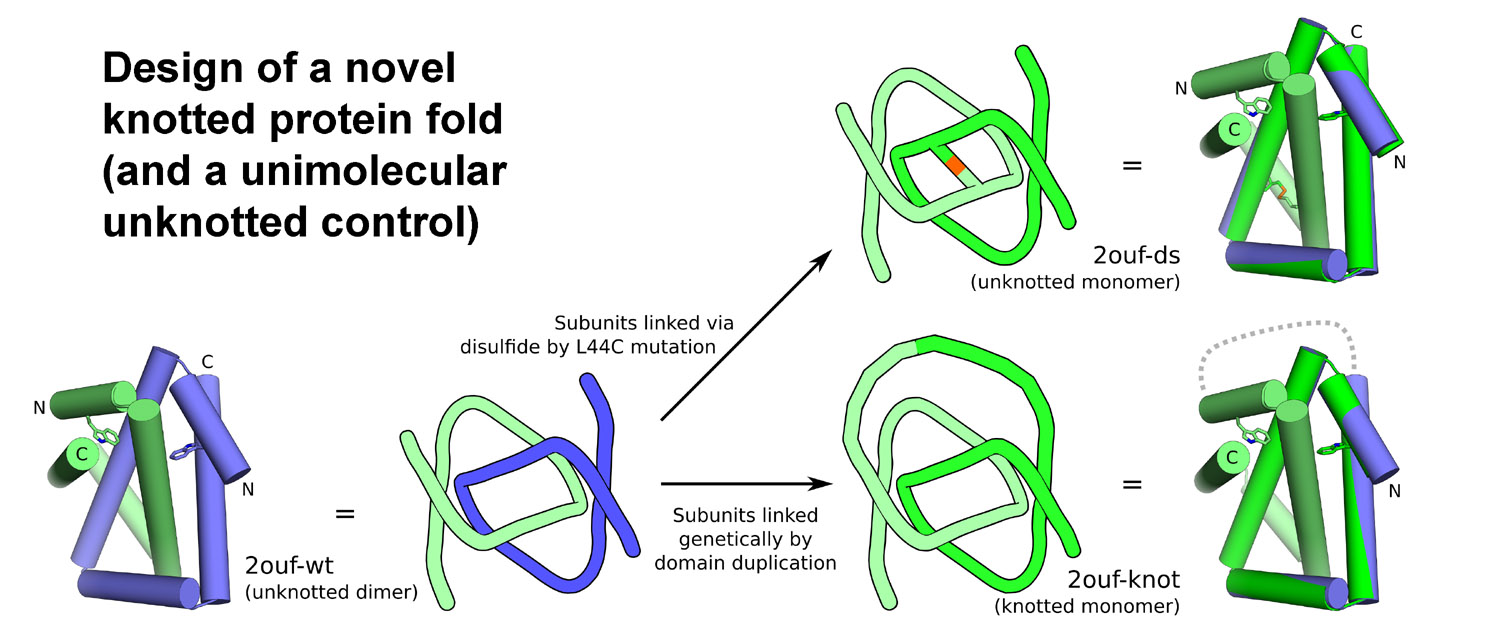
In recent work we have used protein design to generate novel types of protein topologies in order to test the consequences of topological complexity on protein folding, and as a potential avenue for creating interesting types of protein-based materials.